

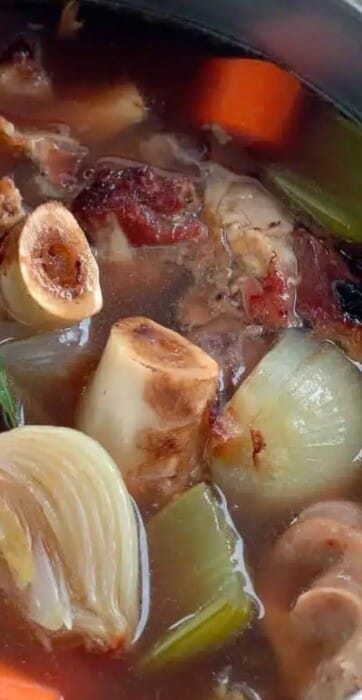
The main stocks used in any kitchen should be veal, chicken, fish and/or shellfish, vegetable, possibly ham, and court bouillon.
A veal base stock can then be enhanced for more specific jobs if required, such as game, lamb and pork, rather than just using a generic stock. Even these can be enhanced further by more specific use of particular bones, such as partridge or pheasant bones, venison, hare or rabbit. This practice, however, applies more to higher-end kitchens, and making these would not be considered normal practice in the vast majority of professional kitchens, sadly.
I use a lot of veal stock with dishes of all kinds; meat sauces, of course, work with all meats but also in many cases go very well with fish, especially some of the more robust fish such as gurnard or monkfish, and also chicken and pork. It is, however, not the easiest of things to make.
In a domestic situation, however, it would be considered overkill to go into such minutiae.
Making stocks is not that difficult, nor does it require a great deal of skill, but more so that it takes time and space to produce a good stock. A good veal or even beef stock needs to cook for a minimum of 8 hours, as it takes at least 6 hours for the bones to give up their natural jelly and even longer to extract all the flavour that is there to be gained from them. Then there is the problem that it is made from veal bones and the ethical question that raises, but these days rose veal bones are available. Personally I have no such qualms, but I know that everyone is not like me. While you can use beef bones as an alternative, they are not as refined as veal, and the stock will not come out with such a clean flavour.
If it is not possible to get veal bones, my preference, rather than using beef bones, would be to use chicken bones with pig’s trotters to help create the jelly a good stock needs.
The resulting sauce may not be as dark, but that is purely aesthetics; it definitely will not be as rich or have the depth of flavour that veal would have, but I suppose everything has its price.
Whichever way you choose, it can, of course, be used as a base sauce for all meat dishes, not only with fish. It does freeze very well and will keep in the refrigerator unfrozen for at least a week. Many chefs roast their vegetables before adding them to the stock, but my preference is to add them fresh towards the latter end of the cooking cycle. This gives the stock a brighter, fresher flavour, and as vegetables will only give flavour until they are cooked and not beyond, there seems little point in cooking them in the stock for hours on end. Fresh herbs too are important, but like vegetables, they will only ever give off so much flavour and are best added when the vegetables are added; before this is both pointless and counterproductive.
It is important that the stock is not allowed to boil prior to straining and skimming. Boiling will cloud the stock; all the impurities, especially the fats, will emulsify with the stock and make it cloudy and greasy. A stock should almost be as clear as a consommé if made correctly.
Never add salt to a stock until after it is reduced completely and only if absolutely necessary (it probably won’t need any seasoning if made correctly).
See each individual stock recipe for more detailed guidance on each one.
While a meat stock such as veal or beef takes a long time to cook, chicken stock takes a lot less time, generally no more than 3 hours, and a fish stock a shorter time still, as 20 minutes is regarded as the optimum cooking time.
All meat stocks can be made either white or brown, but the general norm is for veal, beef and lamb to be brown and the rest white, although brown chicken stocks are not uncommon and have lots of uses.