
Have you ever considered where we would be without eggs? What would breakfast be without them? What would bacon be without them? Pigs would become redundant!
I used to keep chickens myself, something that had long been a desire of mine to do; sadly, I don’t have the garden for them now. I have also kept quails in the past; many years ago now, I had over 250 at one time! I find eggs quite fascinating.
Hens, bantams, ducks, geese, quails, plovers, and even guinea fowl, pheasant and turkey eggs – they are all eaten. Fried, scrambled, hard and soft boiled, poached, en cocotte, coddled, turned into omelettes, put into cakes, into pastry, ice creams, mousses and pates, in mayonnaise, and into sauces, even pickled or dried. Their uses are almost infinite.
I started with 8 birds originally; that number dropped to 7 fairly quickly as one little one succumbed to the jaws of one of my dogs! Unfortunately, out of the original seven, three were cocks. You see, strange as it may seem, there are always more cocks hatched than hens. To avoid confusion, you don’t get eggs from cocks, nor do you need cocks to get eggs!
There is just something about a newly laid egg, and if you’ve never had one, I urge you to stop what you are doing this minute and rush out and find one. Once tried, it is very difficult to go back to those battery-produced offerings. Did you know that about eight out of every ten eggs consumed in this country come from battery chickens and that we eat on average some 10 billion eggs a year! If there is one thing that this county of ours has, it is plenty of free-range eggs. They seem to be for sale everywhere, from car boot sales to stands by the side of the road, from allotments and farmers’ markets to the weekly auctions, so if I were you, I would let the rest of the country eat the battery-farmed eggs while we eat the real ones, and we’ll let it be our secret, shall we?
Venerated as a symbol of life, ancient philosophers saw the egg as a symbol of the world and the four elements. The shell was seen to represent the earth; the white, water; the yolk, fire; and the fourth element, air, was found under the shell at the rounded end. To early Christians, eggs were a symbol of rebirth and were hard-boiled, decorated, and given as presents at Easter time. A practice still carried on today, although most are now in the form of chocolate and start appearing in shops shortly after Christmas!
Larousse Gastronomique, the French bible of ingredients for chefs, lists almost 400 different egg dishes, with almost 100 of them being omelettes. Le Repertoire de la Cuisine, the book that young budding chefs once had to learn parrot fashion from back to front, lists over 300, and its closest rival, Herring’s Dictionary of Classical and Modern Cookery, has a staggering 979 listings for egg dishes. So if you were ever of the opinion that eggs were just for frying, then think again.
Quite simply, eggs have formed an integral and important part of man’s diet for a very long time. Well before chickens were domesticated, man would have plundered the nests of many different birds.
Early Phoenicians thought that the primaeval egg split open to form the heaven and the earth. The ancient Egyptians were convinced that their god Ptah created the egg from the sun and the moon, and the American Indians say that the Great Spirit burst forth from a giant golden egg to create the world.
Rich in symbolism and myth, eggs are associated with new life, renewal, and a new dawning or beginning. For early Christians, eggs became associated with rebirth and, of course, the Resurrection, with rituals being carried forward from pagan times.
In the 4th century the Church had forbidden many foods during Lent, eggs being one. It is thought that this is the reason that eggs became a traditional Shrove Tuesday meal, designed to use up the built-up supplies of eggs and milk from when the fast began. The Church may have prevented its flock from eating eggs, but they could not stop the chickens from laying them!
If we were to go further back in time beyond the early Christians, then we would find that the Chinese had developed a way of preserving eggs as far back as 1400BC, and even further back, we know that the tradition of decorating eggs was carried out in the Ukraine about 3000BC. More recently mediaeval noblemen traditionally gave coloured, hard-boiled eggs to their servants on Easter Day, and today we still carry on the tradition of giving eggs at Easter time to our families.
Eggs have their hold on superstition and old wives’ tales too; one of the most widely known is that eggshells are used in witchcraft. The Romans used to crush eggshells as a precaution; even today there are those that smash eggshells without realising the source of this ancient custom. The tale that the darker the yolk, the richer the egg is a popular old wives’ tale, as is the one about brown eggs being better than white, both of which are quite untrue; it is the breed of chicken that determines the colour of the shell, and what they are fed on determines the colour of the yolk.
Unfortunately, eggs have not always been in as plentiful a supply as they are today. In the 1930s eggs were often the domain of the farmer’s wife – she would rear the hens, sell the eggs, and the profits were regarded as her ‘pin money’. At the time the UK was one of the world’s two major egg-importing countries.
Then, of course, during the war of 1939-45, eggs were rationed, which continued until as late as 1953.
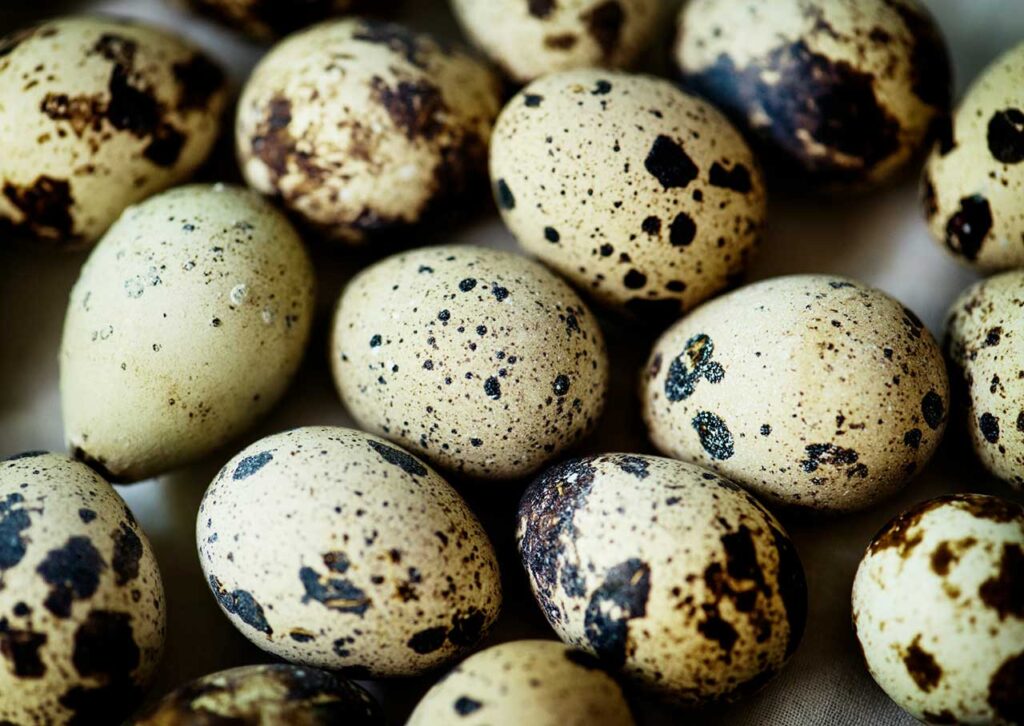
31 cmNow earlier on in this article I mentioned that I had kept quails. The reason for this, quite a logical one at the time, was that I was unable to get a regular supply of quails eggs and good quality quails were also extremely hard to find at the time, so my answer was to breed my own. Starting from just 24 eggs that a friend hatched out for me I had as many as 250 at one time and with the hens producing on average one and a half eggs per day each, that was a lot of eggs! They are by far the most prettiest of all the eggs with a pale greenish beige background covered in dark brown spots of varying sizes and normally they are the smallest of the eggs available commercially – but not mine! I can only put it down to what I was feeding them, but how a bird so small can lay an egg so large is beyond me. One in every three had a double yolk while occasionally there would be a triple yolker! This would be the size of a bantams egg out of a bird the size of a small dove; it used to bring tears to my eyes. But what eggs! They may not have matched the largest hens egg ever laid, which apparently had a remarkable 5 yolks and was some 31cm around the long axis, but they had a flavour second to none.
Duck eggs, with their chalk-white to delicate pale-blue shells, are the next most common of the eggs offered for sale and have always had a problem with salmonella poisoning, much more so than hens’ eggs ever will. This is mainly due to the fact that their shells are so much thinner and more porous than that of the chicken. To ensure they are safe to eat, avoid dirty duck eggs or ones that appear to have been washed. A duck egg has a much higher fat content than hens’ eggs, making them more difficult to digest; they also have a larger yolk too. A good fresh duck’s egg, however, is fantastic, and they also make the most wonderful cakes.
All in all, the humble and often much maligned egg is a thing of wonder; in the kitchen, we have eggs to thank for enabling us to create so many dishes, both savoury and sweet. Their versatility seems limitless; they are like a magical ingredient, creating as they do anything from an emulsion from which we get the likes of mayonnaise and hollandaise; an egg wash that turns pastry a rich and deep golden brown while also sticking breadcrumbs to our food to form a seal against frying; and the white will transform a cloudy liquid into one that is as clear as the finest of crystal. They’re pretty good for dunking soldiers too!
Chef Ian McAndrew’s specialist eBooks and guides are available directly on ChefYesChef, including his technical titles and autobiography. If you want more practical, chef-led reading beyond this article, you’ll find the full collection here.
Chef Ian McAndrew works with chefs, businesses, and individuals on a wide range of culinary projects, from concept development to practical problem-solving.
If you’d like to talk through an idea or need informed guidance, you’re welcome to contact him.